

Affiliate disclosure: White Metal Resources may earn a commission when you open an account through links on this page. This never changes what you pay or what we write. We are not financial or tax advisors. Consult a licensed advisor before making retirement decisions.
Last updated: July 17, 2026 · By White Metal Resources Editorial
Quick answer: A traditional IRA can be moved into a silver IRA at any time by asking your current custodian to send the funds directly to a self-directed IRA custodian. That is a trustee-to-trustee transfer, and it is not counted as a rollover. No mandatory federal withholding applies, no 60-day clock starts, and the one-rollover-per-12-months rule that governs indirect IRA-to-IRA rollovers does not touch it.
Once the cash lands at the new custodian, the account buys IRS-approved silver at a .999 fineness minimum, and an approved depository takes physical possession. The account stays a traditional IRA, so the tax-deferred wrapper is preserved and the taxable moment is pushed to future distributions.
Short on time? The essentials
- Your traditional IRA can move at any age. There is no distributable event to wait for and no employer plan administrator to sign off.
- The cleanest route is a trustee-to-trustee transfer between IRA custodians. It is not counted as a rollover and carries no annual limit.
- The 20% mandatory withholding is a plan-payout rule. It does not apply to IRA-to-IRA transfers, though a 10% default IRA distribution withholding can hit an indirect rollover.
- An indirect IRA-to-IRA rollover is capped at one per rolling 12 months, aggregated across all your IRAs under the Bobrow ruling.
- The silver you buy must be .999 fine. Platinum and palladium must be .9995. Gold must be .995 unless it is an American Gold Eagle.
- The 2026 IRA contribution limit is $7,500, plus a $1,100 catch-up at 50 and over. Rollovers, not fresh contributions, fund silver IRAs.
- A self-directed IRA custodian holds legal title. An approved depository stores the metal. Home storage is a taxable distribution.
- Basis in nondeductible traditional IRA contributions carries over. Track it on IRS Form 8606 so future distributions are not double-taxed.
- Required minimum distributions still apply. The start age is 73 today, rising to 75 in 2033 for people born in 1960 or later.
- Vet the company yourself: a published BBB profile, a written fee schedule, and a named IRS-approved depository before you commit.
This page walks a traditional IRA owner through the mechanics of moving retirement money into a silver IRA. Below we cover what a "traditional IRA to silver IRA" move actually is and why the trustee-to-trustee transfer route beats a 60-day rollover in almost every case.
We also walk through the step-by-step process, the metals that qualify, and the taxes and fees that decide whether the move is worth doing. Every figure traces to an IRS, statute, LBMA, or CFTC source, cited inline.
What moving a traditional IRA into a silver IRA really means
A silver IRA is not a separate tax category. It is a self-directed traditional IRA that holds physical silver instead of shares. The tax wrapper is the same as any traditional IRA. The pre-tax dollars stay pre-tax, and the taxable moment is pushed until you take distributions.
What changes is who administers the account and what it can hold. A brokerage IRA can hold stocks, bonds, and funds. A self-directed IRA at a specialist custodian can also hold IRS-approved physical precious metals under IRC section 408(m). The dealer sells the metal. An approved depository stores it. You direct the choices, but you never take personal possession while the metal remains inside the account.
Worth knowing: "moving" a traditional IRA into a silver IRA is usually a transfer between two custodians, not a rollover in the strict IRS sense. That distinction changes which rules apply and matters for tax planning. It is the subject of the next section.
Trustee-to-trustee transfer or 60-day rollover: which route?
Two mechanics move money between IRAs. Both are legal. Only one is truly clean for most savers.
A trustee-to-trustee transfer moves the funds directly from your current IRA custodian to the new self-directed IRA custodian. You never touch the cash. The IRS does not count this as a rollover at all (source: IRS Publication 590-A). No withholding applies, no 60-day clock starts, and the one-rollover-per-12-months limit does not touch you.
A 60-day rollover, sometimes called an indirect rollover, works differently. Your current custodian pays the money to you. You then have 60 days to redeposit the full amount at the new IRA custodian, or the missed portion becomes a taxable distribution.
Two constraints hit the indirect route. First, only one indirect IRA-to-IRA rollover is permitted in any rolling 12-month window, aggregated across all your IRAs (source: IRS Announcement 2014-15, applying the Bobrow ruling). Second, the default IRA distribution withholding is 10% federal, which the payer applies unless you affirmatively elect out on Form W-4R.
| Feature | Trustee-to-trustee transfer | 60-day (indirect) rollover |
|---|---|---|
| Who receives the check | Your new self-directed IRA custodian | You, personally |
| Counted as an IRS rollover? | No | Yes |
| Default federal withholding | None | 10% unless you elect out on Form W-4R |
| 60-day redeposit deadline | Does not apply | Yes; miss it and it becomes a taxable distribution |
| Limit per rolling 12 months | Unlimited | One indirect rollover across all your IRAs (Bobrow) |
| Risk of an accidental taxable event | Low | Higher, from missed deadline or forgotten shortfall |
| Best for most traditional IRA owners | Yes | Only when a specific cash need justifies it |
Sources: IRS Publication 590-A; IRS Announcement 2014-15 (Bobrow). Checked June 2026.
The step-by-step traditional IRA to silver IRA move
The direct-transfer route is the one most traditional IRA owners should take. Each step below has a specific action.
- Confirm what your current custodian holds. Log in, or call, and confirm the type of IRA (traditional or Roth), the current balance, and any basis you have tracked on IRS Form 8606 for nondeductible contributions.
- Open a self-directed IRA with a qualified custodian. The new custodian is a bank or IRS-approved non-bank trustee. It holds legal title to the account and handles IRS reporting.
- Request a trustee-to-trustee transfer. Sign the new custodian's transfer form. It asks your current custodian to send the funds directly, with no check payable to you. No withholding and no 60-day deadline apply.
- Choose IRS-approved silver. Buy .999 silver coins or bars from approved sources. Favor common bullion over premium numismatic coins, which do not qualify and carry wide dealer spreads.
- Have the depository take physical possession. The IRS-approved depository stores the metal in your IRA's name. You never take personal possession while the metal remains inside the account.
The whole sequence usually takes two to four weeks. The pacing item is your current custodian's transfer processing time, which varies by firm.
Use the calculator below to quickly test whether your traditional IRA is eligible for a transfer today.
Can you roll your account into a precious metals IRA? Eligibility checker
Most retirement money can move into a precious metals IRA once it is an eligible rollover distribution. Pick your account and situation for a general answer. Always confirm the specifics with your plan administrator or custodian.
General guidance only, not tax or financial advice. Eligibility depends on your specific plan document and IRS rules; confirm with your plan administrator and a tax advisor. A direct trustee-to-trustee transfer avoids the 60-day rule and 20% withholding.
Picking a company that explains every fee up front is the first step. Get the free precious metals IRA company checklist.
Which silver, platinum, or palladium can the account hold?
Federal law lists gold, silver, platinum, and palladium as the only metals allowed inside an IRA. Each must meet a minimum fineness drawn from commodity-market delivery standards (source: 26 U.S.C. Section 408(m)). The IRS-recognized minimums are gold .995, silver .999, and platinum or palladium .9995.
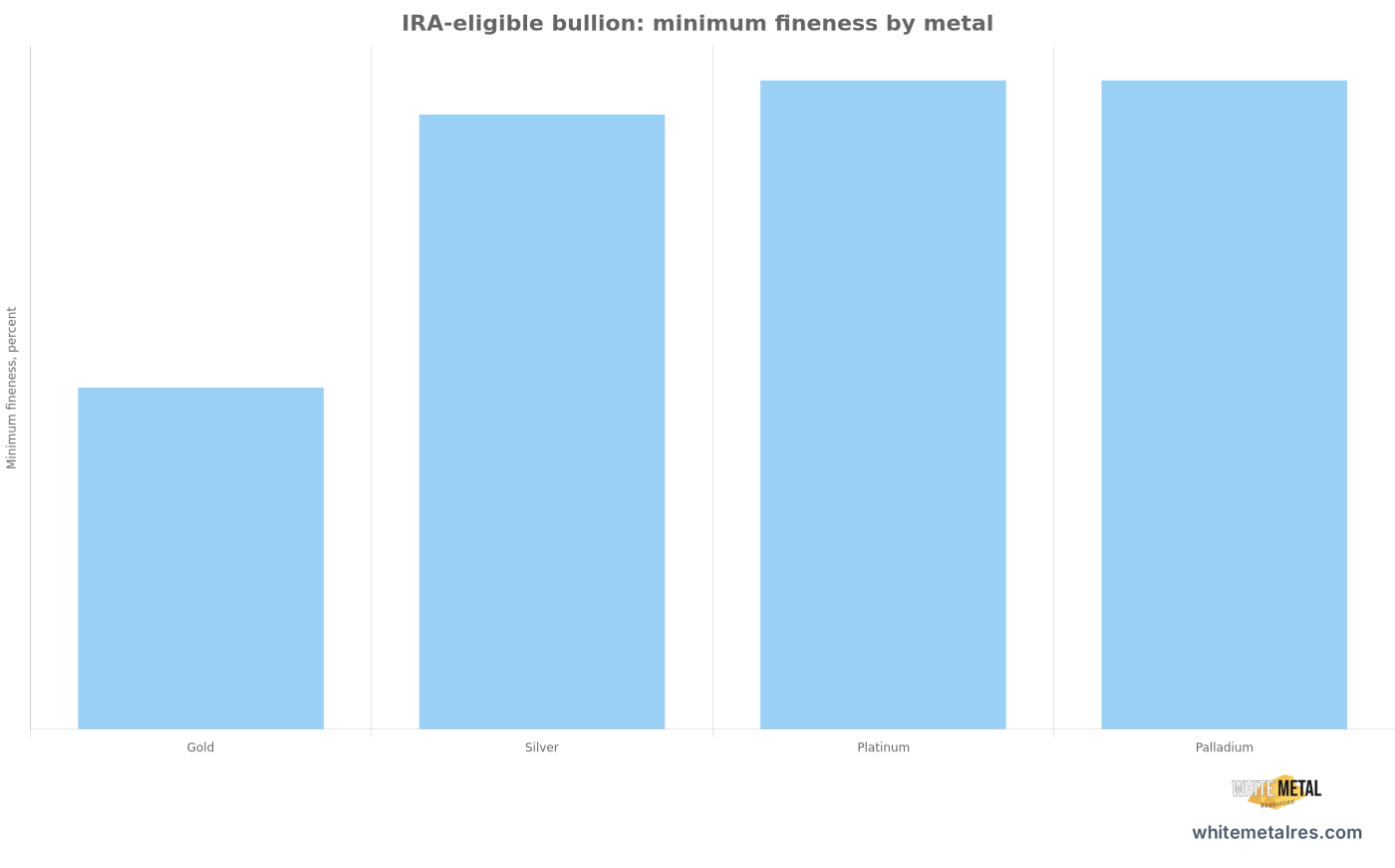
Sovereign coins from major mints commonly qualify. The American Silver Eagle, the Canadian Silver Maple Leaf, and the Austrian Silver Philharmonic all satisfy the .999 test. The Silver, Platinum, and Palladium American Eagles qualify through a separate carve-out for United States coins. Bars must come from a refiner that meets the relevant delivery standard, such as the London Bullion Market Association Good Delivery list (source: LBMA Good Delivery).
| Metal | Minimum fineness | Common eligible products |
|---|---|---|
| Silver | .999 | American Silver Eagle, Canadian Silver Maple Leaf, Austrian Silver Philharmonic, approved refiner bars |
| Platinum | .9995 | Platinum American Eagle, Canadian Platinum Maple Leaf, approved refiner bars |
| Palladium | .9995 | Palladium American Eagle, Canadian Palladium Maple Leaf, approved refiner bars |
| Gold (for context) | .995 | American Gold Eagle via the United States coin carve-out, approved refiner bars |
| Not eligible | n/a | Rhodium, iridium, numismatic and graded coins, generic rounds below the fineness minimum |
Sources: 26 U.S.C. Section 408(m); IRS collectibles issue snapshot. Coin specifications are industry-reported. Checked June 2026.
A common source of buyer regret is a coin that fails the fineness test or the United States coin carve-out. The IRS treats acquiring a "collectible" inside an IRA as a deemed distribution equal to cost, taxed as ordinary income (source: IRS collectibles issue snapshot). See IRA-eligible silver coins for the vetted list.
Why contribution limits push you to a rollover, not fresh cash
The annual IRA contribution limit is small next to the cost of physical metal. That is why almost every silver IRA is funded by moving existing retirement money, not by fresh cash. The chart below shows how the ceiling has moved for 2025 and 2026.
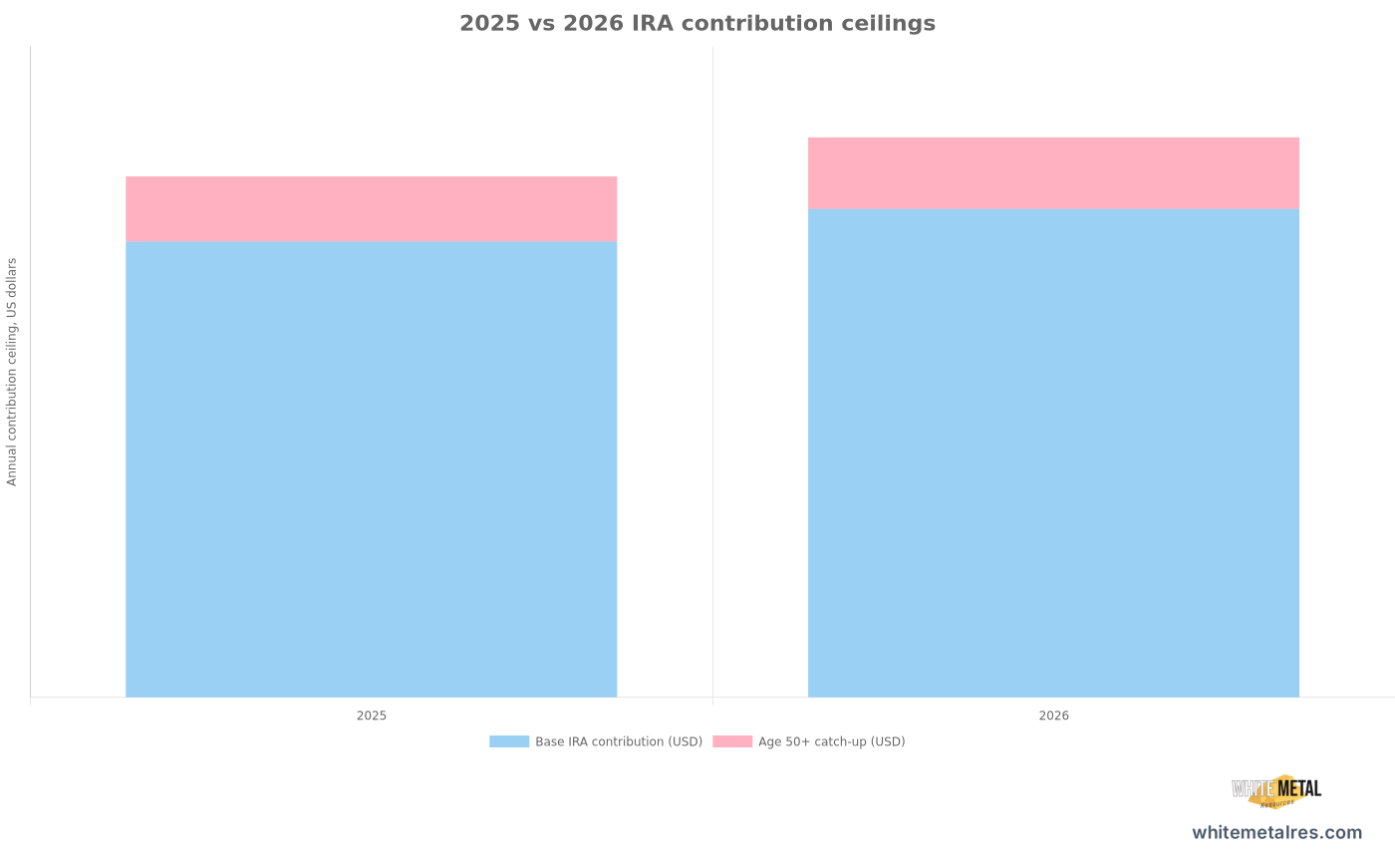
For tax year 2026, the annual IRA contribution limit is $7,500. A $1,100 catch-up applies at age 50 and over (source: IRS, 2026 limits). Rollovers and trustee-to-trustee transfers do not count against that limit, so an entire traditional IRA balance can move at once.
Two deduction phase-outs still matter if you plan to add fresh contributions on top of the transfer. For 2026, the traditional IRA deduction phases out at $81,000 to $91,000 of modified adjusted gross income for a single filer covered by a workplace plan. The phase-out is $129,000 to $149,000 for a married couple filing jointly where the contributor is covered. See silver IRA contribution limits for the full phase-out grid.
Taxes, basis, and the one-per-12-months rule
Done right, moving a traditional IRA into a silver IRA is not a taxable event. Get the mechanics wrong and the tax bill can be sudden. Four federal rules matter most.
The transfer itself is not taxable
A trustee-to-trustee transfer between two traditional IRAs is not a rollover and not a distribution. The IRS does not require reporting on Form 1099-R for a direct transfer between IRAs of the same type. The tax-deferred status of the account is preserved.
The one-rollover-per-12-months rule
If you take an indirect rollover instead, only one is permitted in any rolling 12-month window, aggregated across all your IRAs (source: IRS Announcement 2014-15). This came from the Tax Court's Bobrow ruling. A second indirect rollover inside 12 months is treated as a taxable distribution, plus a 10% penalty if you are under 59.5.
Basis on nondeductible contributions
Some savers made after-tax contributions to a traditional IRA in past years. That basis is tracked on IRS Form 8606 and carries over to the new custodian. Keep every Form 8606 you have ever filed, because the new custodian will not have the history. Without it, a portion of your future distributions could be taxed twice.
The 10% early-withdrawal additional tax on distributions
A distribution before age 59.5 without a qualifying exception is hit with a 10% federal additional tax, on top of ordinary income tax (source: IRS Publication 590-B). Exceptions include disability, certain medical expenses, and substantially equal periodic payments under section 72(t). The transfer itself does not trigger this rule.
Required minimum distributions later
A traditional silver IRA follows the standard RMD rules. The current start age is 73 for people who reached age 72 after December 31, 2022. The start age rises to 75 in 2033 for people born in 1960 or later (source: IRS RMD FAQs).
Estimate your first RMD with the calculator below. It uses the IRS Uniform Lifetime Table for owners whose spouse is not the sole beneficiary or is not more than 10 years younger.
Precious metals IRA required minimum distribution (RMD) estimator
Once required minimum distributions begin (age 73 now, 75 starting 2033), you divide last year-end balance by an IRS life-expectancy factor. Most states tax the result as ordinary income, on top of federal tax. You can take a precious metals IRA RMD in cash or in metal.
Estimate only, not tax advice. Uses the IRS Uniform Lifetime Table (most owners). A spouse more than 10 years younger and sole beneficiary uses a different table. Roth IRAs have no lifetime RMD. Sources: IRS Publication 590-B (Table III); IRS RMD FAQs. Consult your tax advisor.
Picking a company that explains every fee up front is the first step. Get the free precious metals IRA company checklist.
Picture a traditional IRA owner, age 65, retired, with $100,000 to move into a silver IRA. Here is how the two routes play out in the same dollar amount.
- Trustee-to-trustee transfer: the current custodian sends $100,000 straight to the new self-directed IRA custodian. No withholding applies. The full $100,000 is available to buy IRS-approved silver.
- Indirect rollover, no election to waive: the current custodian applies the 10% default federal withholding and sends $90,000 to the owner, remitting $10,000 to the IRS. To complete a full rollover, the owner must deposit $100,000 at the new custodian within 60 days, coming up with $10,000 out of pocket, then reclaim the withheld amount at tax time.
- Indirect rollover, common mistake: the owner deposits only the $90,000 received. The rollover closes at $90,000. The $10,000 shortfall is a taxable distribution, and the 10% additional tax also applies at any age under 59.5.
The figures above are illustrative. They show why the direct transfer avoids the paperwork and cash flow that catch first-time indirect rollovers. This is an illustration, not tax advice; consult a licensed advisor for your situation. The account also keeps the family legacy tidy for your spouse or heirs later.
What a silver IRA rollover really costs
A silver IRA carries costs a plain brokerage IRA does not. Knowing them up front is the difference between a fair account and a poor one.
Expect a one-time setup fee, an annual custodian or administration fee, and an annual storage fee paid to the depository. On top of those sits the dealer's spread, the gap between what you pay for the metal and what it would sell for the same day. The spread is usually the largest lifetime cost, and it is the one least often disclosed clearly.
Silver adds a small wrinkle. Because silver is bulkier than gold for the same dollar value, storage can run higher per dollar invested. Segregated storage keeps your specific coins or bars apart and costs more. Commingled storage pools metal of the same type and costs less. See silver IRA fees explained and segregated versus commingled storage.
The trade-off: low published fees can hide a wide dealer spread, while a fair spread can sit beside higher storage fees. Compare the all-in cost, not one line. A clean fee structure also keeps the account simple for the last 50 years of inflation cycles ahead of you and the next generation who may inherit it.
The calculator below estimates how annual fees compound against the account over time.
Precious metals IRA fee-drag calculator
Precious metals IRAs charge mostly flat dollar fees (setup, annual custodian, storage). Flat fees take a much bigger bite out of a small account than a large one. Enter your numbers to see the drag.
Estimate only. Fee amounts vary by provider and are often not published; enter figures you confirm in writing. This tool ignores metal price changes and the dealer spread, which also affect returns. Not financial advice.
Picking a company that explains every fee up front is the first step. Get the free precious metals IRA company checklist.
How to pick a company that will not push numismatic coins
The company you pick shapes your fees, your metal choices, and your risk of a coin upsell. A short checklist filters most of the field.
Verify the basics yourself, not from the sales call. Check the firm's Better Business Bureau rating and accreditation date, confirm how long it has operated, and ask for the fee schedule in writing before you commit. Favor firms that present common .999 bullion plainly and do not steer you toward premium graded coins. Confirm the custodian and depository are named and IRS-approved.
Federal regulators do act in metals markets. In a 2020 order, the U.S. Commodity Futures Trading Commission required JPMorgan Chase and subsidiaries to pay a total of $920.2 million over spoofing. The regulator said the conduct spanned gold, silver, platinum, and palladium futures (source: CFTC release 8260-20).
What you will need to verify: a published BBB profile, a clear written fee schedule, a named IRS-approved depository, and a salesperson who answers "who is this not for" honestly. A firm that dodges any of those is telling you something. See how to compare silver IRA companies.
When moving your traditional IRA into silver is a bad idea
A balanced look has to name when this move works against you. For several savers, a traditional IRA to silver IRA rollover is the wrong call, and saying so plainly is part of an honest guide.
It is usually a bad idea in these situations:
- A small balance against the fee drag. Setup, annual custodian, storage, and the dealer spread are largely fixed. On a small account those costs eat a large share of the balance. Silver's bulk makes the storage piece a little heavier than gold's.
- You may need the money within a few years. Silver is volatile short-term, and selling means crossing the dealer spread again. Before age 59.5 you also owe the 10% federal additional tax on top of ordinary income tax.
- You have no other retirement savings yet. Concentrating your only retirement money in one asset class leaves no buffer. A broad base usually comes first, with metal as a portion rather than the whole.
- Your current traditional IRA has low-cost index funds you would give up. If your existing custodian charges next to nothing and offers cheap index funds, the fees inside a silver IRA have to earn that gap back before the move delivers value.
- You are chasing a guaranteed return. Nobody can predict where silver prices will go. A pitch that promises guaranteed gains is a warning sign, not an opportunity, and is exactly the pattern regulators have acted on.
If one of these describes you, slowing down is the sensible call. The fixed annual costs and the dealer spread both punish a short or small position more than most savers expect. There is no CTA in this section on purpose.
Traditional IRA to silver IRA questions, answered
Can I move a traditional IRA into a silver IRA at any age?
Yes. Unlike a 401(k), 403(b), or TSP, a traditional IRA does not need a distributable event to move. A trustee-to-trustee transfer is available at any age, with no employer administrator involved. Distributions from the new IRA still follow the standard 59.5 and RMD rules.
Is the transfer between two traditional IRAs taxable?
A properly executed trustee-to-trustee transfer is not taxable and is not treated as a rollover for IRS purposes. The pre-tax status of the funds is preserved. The taxable moment comes later, when you take distributions from the new silver IRA in retirement.
Does the 20% mandatory withholding apply to my traditional IRA?
No. The 20% mandatory federal withholding is a plan-payout rule for 401(k), 403(b), 457(b), and TSP distributions. IRA distributions to the owner carry a 10% default federal withholding instead, which the owner can waive on IRS Form W-4R. A direct transfer avoids withholding entirely.
How many indirect rollovers can I do in a year?
Only one indirect IRA-to-IRA rollover in any rolling 12-month window, aggregated across all your IRAs. That is the Bobrow ruling, codified by IRS Announcement 2014-15. Trustee-to-trustee transfers are not counted against this limit, so you can transfer as often as needed.
What silver qualifies for the new IRA?
Silver at a .999 fineness minimum qualifies. Common eligible coins include the American Silver Eagle, the Canadian Silver Maple Leaf, and the Austrian Silver Philharmonic, plus bars from approved refiners. Numismatic and graded rare coins outside the United States coin carve-out do not qualify.
Can I move part of my traditional IRA and keep the rest at the current custodian?
Yes. Partial transfers are permitted. Many savers move a portion of a traditional IRA into physical silver and keep the rest in low-cost index funds at the existing brokerage IRA. This limits the fee drag while adding a metal position.
What happens to my basis on nondeductible contributions?
Basis in nondeductible traditional IRA contributions carries over with the transfer. It is tracked on IRS Form 8606, which you file with your tax return. Keep every past Form 8606, because the new custodian will not have the history and cannot recompute it for you.
Do I still owe RMDs on the new silver IRA?
Yes. A traditional silver IRA follows the standard RMD rules. The start age is 73 today, rising to 75 in 2033 for people born in 1960 or later. Roth IRAs have no RMD during the owner's lifetime. Consult your tax advisor for how the rules apply to your situation.
Sources
- IRS, Publication 590-A, Contributions to Individual Retirement Arrangements. Checked June 2026.
- IRS, Publication 590-B, Distributions from Individual Retirement Arrangements. Checked June 2026.
- IRS Newsroom, 2026 retirement plan and IRA limits (Notice 2025-67). Checked June 2026.
- IRS, Required Minimum Distributions FAQs. Checked June 2026.
- IRS, Investments in collectibles in individually directed qualified plan accounts (Issue Snapshot). Checked June 2026.
- IRS Announcement 2014-15 (application of the one-rollover-per-year limitation under Bobrow). Checked June 2026.
- Cornell Legal Information Institute, 26 U.S.C. Section 408. Checked June 2026.
- London Bullion Market Association, Good Delivery. Checked June 2026.
- U.S. Commodity Futures Trading Commission, Release 8260-20 (JPMorgan order). Checked June 2026.
