

Editorial note: White Metal Resources publishes independent research on silver, platinum and palladium. This page has no paid placement, no affiliate link and no advertising sponsorship. We are not financial or tax advisors. Consult a licensed advisor before making investment or retirement decisions.
Last updated: August 15, 2026 · By White Metal Resources Editorial
Quick answer: Ruthenium is a hard, brittle, silvery-white platinum-group metal with the symbol Ru and atomic number 44. Roughly 30 tonnes are mined each year, mostly as a byproduct of South African platinum ores, per Wikipedia and the USGS Mineral Commodity Summaries 2025.
Its main uses are wear-resistant electrical contacts, thick-film chip resistors, hard-disk drive coatings, industrial catalysts (including the KBR Advanced Ammonia Process and Grubbs olefin metathesis) and platinum jewelry alloys. There is no sovereign bullion coin, no widely traded spot ETF and no CME Group futures contract. Ruthenium is also not IRA-eligible under IRS rules.
Short on time? The essentials
- Ruthenium is a platinum-group metal (PGM), symbol Ru, atomic number 44, with a density of 12.364 grams per cubic centimeter and a melting point of 2,334 degrees Celsius.
- It was discovered in 1844 by the Baltic-German chemist Karl Ernst Claus at Kazan State University and named after Ruthenia, the Latin name for Russia.
- Roughly 30 tonnes are mined each year, with world reserves estimated at about 5,000 tonnes, according to Wikipedia; annual production rose from about 19 tonnes in 2009 to 35.5 tonnes in 2017.
- USGS estimated the annual average ruthenium price at 440 dollars per troy ounce in 2024, down about 6 percent from 466.49 dollars in 2023, after 576 dollar highs in 2021 and 2022.
- Electronics is the single largest use category, covering barrier layers, transistor gates and interconnects in microelectronic devices, and hard-disk drive coatings that use a three-atom-thick ruthenium layer between magnetic films.
- Ruthenium metal is also used in wear-resistant electrical contacts, thick-film chip resistors based on ruthenium dioxide, small alloying additions that harden platinum and palladium jewelry, and industrial catalysts including Grubbs olefin metathesis and the KBR Advanced Ammonia Process (KAAP), used commercially since 1992.
- There is no mainstream retail investment market. No sovereign mint issues a ruthenium bullion coin, no widely traded spot ETF exists, LBMA has no ruthenium auction and CME Group has no ruthenium futures contract; trade is wholesale between refiners, industrial users and specialist bullion houses.
- Ruthenium is not IRA-eligible under IRS rules; only the four metals listed in Internal Revenue Code section 408(m)(3), gold, silver, platinum and palladium, qualify at set fineness thresholds.
This page is for readers who ran into the word ruthenium in a chemistry article, a jewelry hallmark, a spec sheet for a hard drive or a story about industrial catalysts. The sections that follow cover what the metal is, where it comes from, what it costs and why an ordinary investor cannot really buy it. Every figure below traces to a primary source cited inline.
What is ruthenium?
Ruthenium is a chemical element with the symbol Ru and atomic number 44. It sits in group 8 of the periodic table, between technetium and rhodium, and it is one of the six platinum-group metals (PGMs), alongside palladium, platinum, iridium, osmium and rhodium.
Wikipedia describes ruthenium as "a polyvalent hard white metal" that is a member of the platinum group (source: Wikipedia, Ruthenium, checked August 2026). Its density is 12.364 grams per cubic centimeter at 20 degrees Celsius.
The metal melts at 2,334 degrees Celsius (2,607 kelvin) and boils at 4,150 degrees Celsius. It has a Mohs hardness of 6.5 and does not tarnish at ambient conditions, although it oxidizes when heated in air above 800 degrees Celsius. Its electrical resistivity at zero degrees Celsius is only 71 nano-ohm meters.
Karl Ernst Claus, a Russian scientist of Baltic-German ancestry, isolated the element in 1844 at Kazan State University. He named it after Ruthenia, the Latin name for Russia (source: Wikipedia, Ruthenium). Ruthenium was the last of the six platinum-group metals to be identified.
How rare is ruthenium?
Ruthenium is one of the rarer elements in the Earth's crust. Wikipedia states that "roughly 30 tonnes of ruthenium are mined each year, and world reserves are estimated at 5,000 tonnes" (source: Wikipedia, Ruthenium, checked August 2026).
Annual production has risen over time. The same Wikipedia article reports that output climbed "from about 19 tonnes in 2009 to 35.5 tonnes in 2017" as demand for chip resistors and hard-disk coatings grew.
For scale, worldwide new-mine platinum production was about 170,000 kilograms (170 tonnes) in 2024 and palladium about 190,000 kilograms (190 tonnes), based on USGS estimates (source: USGS Mineral Commodity Summaries 2025, Platinum-Group Metals, checked August 2026). Ruthenium output is roughly one twentieth of platinum output on a new-mine basis.
United States imports for consumption of ruthenium were about 10,000 kilograms in 2024, down from 10,800 kilograms in 2023, per USGS. That number puts the entire annual US intake at roughly one third of world production.
Where ruthenium is mined and how it is recovered
Ruthenium is not mined on its own. It is recovered as a byproduct of primary platinum and nickel-copper deposits, and its output tracks the production plans for those larger metals.
The single largest source is the Bushveld igneous complex in South Africa, where the mined PGM concentrate contains about 11 percent ruthenium on average, according to Wikipedia (source: Wikipedia, Ruthenium). The Norilsk copper-nickel deposits in Russia yield a leaner mix that contains only about 2 percent ruthenium, and the Sudbury Basin in Ontario contributes small but commercially useful quantities from pentlandite ores.
Because ruthenium is a byproduct, its supply does not respond quickly to price. If ruthenium alone rallies but platinum stays weak, mines do not open new capacity, because platinum revenue still dominates the mine plan. That structural trait is one reason ruthenium prices can move sharply on modest demand shifts.
Refining runs after the primary PGM concentrate is produced. Ruthenium is separated by oxidation to volatile ruthenium tetroxide, then reduced back to the metal. The refining step is dominated by a small group of specialist companies, including LBMA-listed platinum-group refiners in South Africa, Europe, Japan and the United States. The refined metal is sold directly to industrial buyers and to specialist bullion houses, not on a public exchange.
What ruthenium is used for
Ruthenium's uses are almost entirely industrial and electronic. The categories below cover most of its annual consumption.
Microelectronics, transistor gates and interconnects
Wikipedia states that "electronics is the largest use of ruthenium" (source: Wikipedia, Ruthenium). Ruthenium metal is non-volatile, which is useful in microelectronic devices, and copper can be electroplated directly onto ruthenium. That combination makes it a common choice for barrier layers, transistor gates and interconnects in advanced chip designs.
Hard-disk drive coatings
Modern hard-disk platters use a very thin ruthenium layer to defeat the superparamagnetic limit that would otherwise cap areal density. Wikipedia's hard-disk article describes two parallel magnetic layers separated by a three-atom layer of non-magnetic ruthenium. The two layers are magnetized in opposite orientation and reinforce each other (source: Wikipedia, Hard disk drive, checked August 2026).
Thick-film chip resistors and electrical contacts
Most surface-mount chip resistors on modern printed circuit boards use a thick-film paste based on ruthenium dioxide. Ruthenium and its main oxide have similar electrical resistivity, which lets designers tune the sheet resistance by adjusting the paste blend. Ruthenium is also widely used for wear-resistant electrical contacts, where a thin plated film delivers long service life at low material cost.
Industrial catalysts and ammonia synthesis
Ruthenium-based compounds catalyze several industrial reactions. Grubbs' catalyst, which earned the 2005 Nobel Prize in Chemistry for its inventor, is used in alkene metathesis and in the commercial production of polymers such as polynorbornene (source: Wikipedia, Ruthenium). Chiral ruthenium complexes introduced by Ryoji Noyori won a share of the 2001 Nobel Prize for asymmetric hydrogenation of ketones, aldehydes and imines.
Ruthenium is also an alternative to iron in ammonia synthesis. Wikipedia's article on the Haber process notes that "ruthenium-activated carbon-based catalysts have been used industrially in the KBR Advanced Ammonia Process (KAAP) since 1992" (source: Wikipedia, Haber process, checked August 2026). Ruthenium-promoted cobalt catalysts are also used in Fischer-Tropsch synthesis of liquid fuels from syngas.
Alloys, jewelry and corrosion resistance
Small additions of ruthenium harden platinum and palladium and improve their wear resistance. That is why the "platinum 950" alloy used in Western jewelry is often 95 percent platinum plus 5 percent ruthenium. Ruthenium also markedly increases the corrosion resistance of titanium when added in small amounts, and a ruthenium and molybdenum alloy becomes superconductive below 10.6 kelvin.
Emerging applications
Two newer uses appear in the technical literature. Ruthenium-based dyes are components of dye-sensitized solar cells, a low-cost photovoltaic architecture (source: Wikipedia, Ruthenium). Ruthenium is also the leading candidate for the capping layer on extreme ultraviolet (EUV) photomasks used in advanced semiconductor lithography, because it survives the intense EUV plasma while protecting the underlying multilayer stack.
The ruthenium price and how the market works
There is no daily public benchmark auction for ruthenium. The London Bullion Market Association only runs daily auctions for gold, silver, platinum and palladium (source: LBMA, About LBMA Daily Auction Prices, checked August 2026). Specialist refiners such as Johnson Matthey and Heraeus post reference prices during business hours, and those quotes drive most wholesale trade.
USGS publishes an estimated annual average price in its Mineral Commodity Summaries, sourced from Engelhard unfabricated metal averages via S and P Global Platts Metals Week (source: USGS Mineral Commodity Summaries 2025, Platinum-Group Metals, checked August 2026). The 2020 to 2024 series shows how a thin market can move.
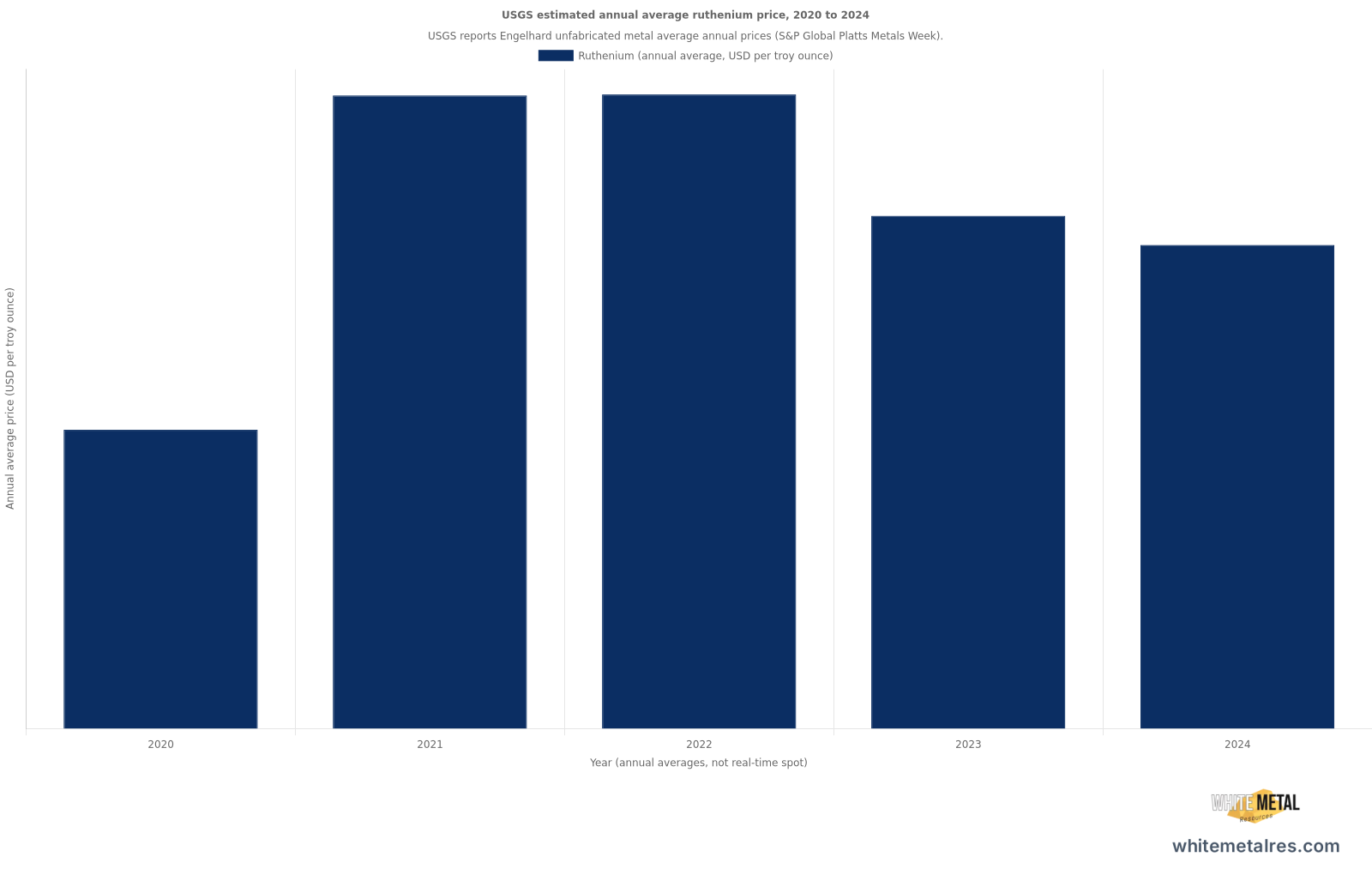
The USGS annual averages ran 271.83 dollars per troy ounce in 2020, 576.12 dollars in 2021, 577.02 dollars in 2022, 466.49 dollars in 2023 and about 440 dollars in 2024. USGS attributes the 2024 decline of roughly 6 percent to weaker demand, investor uncertainty and oversupply.
A doubling of the annual average from one year to the next is not unusual in a market whose entire yearly output fits in the back of a delivery truck. Buyers are almost all industrial firms working under signed offtake or reference contracts, and prices are negotiated bilaterally rather than shouted across a trading pit.
The worked example below shows how to compute a rough metal value for a small piece of ruthenium. It uses raw dollars first, then a share, and every number is labeled as an illustration.
Picture a semiconductor supplier selling a spent ruthenium sputtering-target fragment that weighs 100 grams and is essentially pure ruthenium metal. Assume, illustratively, that the reference price that week is 440 dollars per troy ounce, consistent with the USGS 2024 estimated annual average.
- Convert grams to troy ounces: 100 grams divided by 31.1035 grams per troy ounce equals 3.215 troy ounces of ruthenium content.
- Compute the raw metal reference: 3.215 troy ounces multiplied by 440 dollars per troy ounce equals 1,414 dollars of metal value at the illustrative reference price.
- A refiner's offer will sit below this figure, because it includes a refining, assay and margin charge. Actual haircuts on small parcels of pure ruthenium are qualitatively meaningful, not a few basis points; ask two refiners for a written quote before shipping any material.
- On a plated part, an alloy or a used thick-film paste, the metal content must be assayed first; a nominal 100 gram piece may contain far less than 100 grams of ruthenium once the substrate and other alloy components are subtracted.
These numbers are illustrative, not quotes from any refiner and not a forecast of future prices. They show how to convert a mass and a reference quote into a rough metal value, not what any given piece is worth on any given day. This is an illustration, not financial advice.
Why there is essentially no retail ruthenium product
An investor who wants to buy ruthenium the way one buys a gold coin or a silver bar hits several practical walls at once. Each one alone would keep the retail market small; together they close the door almost entirely.
The list below covers the main reasons.
- No sovereign mint issues a ruthenium bullion coin at meaningful scale. The US Mint, Royal Canadian Mint, Perth Mint and Royal Mint produce gold, silver, platinum and palladium bullion coins, but none issues a mainstream ruthenium bullion coin. A handful of private mints and specialty dealers have offered small ruthenium rounds and bars over the years; those pieces trade in specialist collector channels, not in an active bullion market.
- Ruthenium is hard to work at scale. Its melting point of 2,334 degrees Celsius and its brittleness at room temperature make it hard to cast, roll or strike. Sovereign mints price in reliable, repeatable production, and ruthenium does not fit that profile at the scale a bullion program requires.
- There is no widely traded spot ruthenium ETF. The physically backed ETFs that hold platinum and palladium (such as the products from abrdn or Sprott) have no ruthenium counterpart trading with meaningful volume on a major US exchange. Without a liquid vehicle, retail participation stays negligible.
- CME Group has no ruthenium futures contract. Platinum and palladium each trade as standardized NYMEX futures with a public settlement price. Ruthenium does not, which removes the public price-discovery anchor that a retail bullion market relies on.
- Bid-ask spreads on small pieces are wide. With annual world production of about 30 tonnes, any specialist bullion dealer who takes a small ruthenium piece must warehouse it until an industrial buyer needs it. That inventory risk shows up as a wide spread between the buy and the sell side, which crushes a retail investor's round-trip economics.
- Wholesale trade is negotiated, not quoted. Industrial buyers sign offtake contracts with refiners and specialist bullion houses. That is where the metal flows; it is not a place an individual investor can plug into with a small order.
The short answer is that ruthenium behaves like a specialty industrial input, not like a monetary metal. The retail ecosystem (mint programs, ETFs, futures, dealer sheets) that surrounds gold and silver does not exist for ruthenium.
Why ruthenium is not IRA-eligible
Even if a retail ruthenium market existed, the metal would not be eligible for a US self-directed individual retirement account. The IRS rule is closed-ended and short.
Internal Revenue Code section 408(m)(3) lists the only four metals allowed in a precious metals IRA: gold, silver, platinum and palladium, each at specified fineness thresholds (source: Cornell Legal Information Institute, 26 U.S. Code 408, checked August 2026). Ruthenium, rhodium, iridium and osmium are not on that list, and no IRS ruling extends the definition.
Held in a taxable brokerage account or a specialist dealer relationship, ruthenium is a normal industrial holding subject to standard tax treatment. Held in a retirement account, it would trigger the disallowed-property rules and could deem the account distributed. That is a hard rule with no work-around.
Readers who want the full mechanic of the IRS rule and how it applies to the minor PGMs can read our companion page: why rhodium and iridium are not IRA-eligible. The same reasoning covers ruthenium and osmium.
Ruthenium compared with the other platinum-group metals
The table below places ruthenium alongside its two IRA-eligible relatives (platinum and palladium) and its two other "minor" PGM siblings (iridium and rhodium), using the same USGS data source where possible. It is a quick reference, not a ranking.
| Feature | Ruthenium | Platinum | Palladium | Iridium | Rhodium |
|---|---|---|---|---|---|
| Symbol / atomic number | Ru / 44 | Pt / 78 | Pd / 46 | Ir / 77 | Rh / 45 |
| Density (g/cm3) | 12.36 | 21.45 | 12.02 | 22.56 | 12.41 |
| Melting point (deg C) | 2,334 | 1,768 | 1,555 | 2,446 | 1,964 |
| World mine production (approx.) | about 30 tonnes / year (Wikipedia) | about 170 tonnes (USGS 2024e) | about 190 tonnes (USGS 2024e) | about 6.8 tonnes (2023, Wikipedia) | about 20 to 30 tonnes (industry estimates) |
| USGS 2024 avg price (USD/oz t) | 440 | 950 | 980 | 4,800 | 4,600 |
| Public daily benchmark | None; refiner reference prices only | LBMA Platinum Price twice daily | LBMA Palladium Price twice daily | None; refiner references only | Johnson Matthey reference; no LBMA fix |
| CME Group futures | None | NYMEX platinum, 50 troy oz | NYMEX palladium, 100 troy oz | None | None |
| Sovereign bullion coin | No mainstream program | American Platinum Eagle and others | American Palladium Eagle and others | No mainstream program | No mainstream program |
| IRA-eligible (IRC 408(m)(3)) | No | Yes at 0.9995 fineness | Yes at 0.9995 fineness | No | No |
| Dominant end uses | Chip resistors, hard-disk coatings, electrical contacts, catalysis (KAAP, Grubbs), platinum 950 jewelry alloy | Autocatalysts, jewelry, industrial catalysts, investment | Autocatalysts, electronics, dental, investment | Spark plugs, crucibles, chloralkali electrodes, PEM electrolyzer anodes, Ir-192 | Autocatalysts (gasoline three-way), glass manufacturing |
Sources: USGS Mineral Commodity Summaries 2025, Platinum-Group Metals; Wikipedia entries for Ruthenium, Iridium, Platinum, Palladium and Rhodium; LBMA, About LBMA Daily Auction Prices; CME Group product pages. Checked August 2026. World mine production for rhodium and ruthenium relies on industry estimates rather than USGS mine-production totals.
Limits and caveats
Everything above describes the ruthenium market as it stands in August 2026. A few honest caveats belong on a reference page like this one.
- Production and price figures come from published sources. USGS Mineral Commodity Summaries reports prices with a lag; Wikipedia's tonnage numbers rely on trade press. Real-time quotes from Johnson Matthey, Heraeus and Umicore differ, and the market has no single public tape.
- A retail ruthenium market could develop. A private mint could launch a coin program, an ETF sponsor could file for a physically backed vehicle, or CME Group could list a futures contract. Any of those would change the picture. None is announced at the time of writing.
- The IRS rule is what it is. Ruthenium is not in Internal Revenue Code section 408(m)(3). Only Congress can change that list, and no bill on the table proposes it. Anyone selling ruthenium as a retirement-account investment is misrepresenting the rule.
- Nobody can predict where the ruthenium price will go. A thin market with mostly industrial demand can move sharply on modest supply or demand shifts. Reading the mechanism helps you understand the quote; it does not turn a quote into a strategy.
- This is not financial advice. A reference page can explain what ruthenium is and why the retail market barely exists. Choosing whether to hold PGMs at all, and in what form, is a personal decision that belongs with a licensed advisor familiar with your situation.
Ruthenium questions, answered
What is ruthenium used for?
Ruthenium's largest use is electronics. Wikipedia says that "electronics is the largest use of ruthenium", covering barrier layers, transistor gates and interconnects in microelectronic devices. Modern hard-disk drive platters use a three-atom-thick ruthenium layer between magnetic films. Ruthenium is also used in wear-resistant electrical contacts, thick-film chip resistors based on ruthenium dioxide, industrial catalysis (Grubbs olefin metathesis, Noyori asymmetric hydrogenation, KBR Advanced Ammonia Process), and small alloying additions that harden platinum and palladium jewelry.
How rare is ruthenium?
Ruthenium is one of the rarer elements in the Earth's crust. Wikipedia states that "roughly 30 tonnes of ruthenium are mined each year, and world reserves are estimated at 5,000 tonnes". Annual production rose from about 19 tonnes in 2009 to 35.5 tonnes in 2017. It is recovered as a byproduct of primary platinum and nickel-copper mining rather than at dedicated ruthenium mines.
Who discovered ruthenium and where?
Ruthenium was identified in 1844 by Karl Ernst Claus, a Russian chemist of Baltic-German ancestry, at Kazan State University. Claus isolated the metal from residues left over from platinum-refining work by earlier chemists. He named it after Ruthenia, the Latin name for Russia. Ruthenium was the last of the six platinum-group metals to be identified.
Why can I not buy ruthenium bullion coins?
No major sovereign mint issues a ruthenium bullion coin at meaningful scale. Ruthenium melts at 2,334 degrees Celsius and is brittle at room temperature, which makes it hard to work at the reliability a mint program needs.
There is also no widely traded spot ruthenium ETF and no CME Group ruthenium futures contract, so a retail bullion program would lack the price-discovery infrastructure that surrounds gold and silver. Private mints have produced small ruthenium rounds and bars in the past; those pieces trade in specialist collector channels, not in an active bullion market.
Can I hold ruthenium in a self-directed IRA?
No. Internal Revenue Code section 408(m)(3) lists only four metals as eligible for a precious metals IRA: gold, silver, platinum and palladium, each meeting specified fineness thresholds. Ruthenium, rhodium, iridium and osmium are not on that list. Holding ruthenium inside an IRA would trigger the disallowed-property rules and could deem the account distributed. Our companion page on why rhodium and iridium are not IRA-eligible covers the mechanic in full.
Where does ruthenium come from?
Ruthenium is a byproduct of primary platinum and nickel-copper mining. The largest source is the Bushveld igneous complex in South Africa, where the mined PGM concentrate contains about 11 percent ruthenium on average. Norilsk in Russia yields a leaner mix at about 2 percent, and the Sudbury Basin in Ontario contributes small but useful quantities from pentlandite ores. Refining is done by a small group of specialist companies in South Africa, Europe, Japan and the United States.
What is ruthenium’s role in hard-disk drives?
Modern hard-disk platters use a very thin ruthenium layer to raise areal density past the superparamagnetic limit. Wikipedia's hard-disk article explains that "the platters are coated with two parallel magnetic layers, separated by a three-atom layer of the non-magnetic element ruthenium, and the two layers are magnetized in opposite orientation, thus reinforcing each other". The mass of ruthenium in any single drive is very small, but the combined volume across the industry supports a meaningful share of annual demand.
Is there a daily ruthenium spot price?
No published exchange auction sets an official daily ruthenium spot price. LBMA runs auctions only for gold, silver, platinum and palladium. USGS publishes an estimated annual average price in Mineral Commodity Summaries, based on Engelhard unfabricated metal averages sourced from S and P Global Platts Metals Week. Specialist refiners such as Johnson Matthey and Heraeus post reference prices during business hours, and those quotes drive most wholesale trade.
Sources
- U.S. Geological Survey, Mineral Commodity Summaries 2025, Platinum-Group Metals (annual ruthenium data 2020 to 2024; US imports of 10,000 kilograms in 2024e; world platinum and palladium mine production; estimated annual average ruthenium price of 440 dollars per troy ounce in 2024, down 6 percent from 2023). Checked August 2026.
- Wikipedia, Ruthenium (symbol Ru, atomic number 44; density 12.364 g/cm3; melting point 2,334 deg C; Karl Ernst Claus 1844 at Kazan State University; about 30 tonnes mined each year with 5,000 tonnes reserves; production rose from 19 tonnes in 2009 to 35.5 tonnes in 2017; largest use in electronics; Grubbs catalyst and Noyori asymmetric hydrogenation). Checked August 2026.
- Wikipedia, Hard disk drive (three-atom-thick non-magnetic ruthenium layer between the two coupled magnetic layers on modern platters, used to defeat the superparamagnetic limit). Checked August 2026.
- Wikipedia, Haber process (ruthenium-activated carbon-based catalysts used industrially in the KBR Advanced Ammonia Process (KAAP) since 1992, as an alternative to the classic iron-based Haber-Bosch catalyst). Checked August 2026.
- London Bullion Market Association, About LBMA Daily Auction Prices (twice-daily gold, silver, platinum and palladium benchmarks; no LBMA daily auction exists for ruthenium, rhodium, iridium or osmium). Checked August 2026.
- Legal Information Institute, 26 U.S. Code section 408 (defines a precious metals IRA and the eligible-metals list at 408(m)(3), which covers gold, silver, platinum and palladium at specified fineness only). Checked August 2026.
- CME Group, Platinum Futures product page (standardized 50 troy oz NYMEX platinum contract, illustrating the exchange-traded infrastructure that ruthenium does not have). Checked August 2026.
