

Affiliate disclosure: White Metal Resources may earn a commission when readers open an account through links on this site. That never changes what you pay or what we write. We are not financial or tax advisors. Consult a licensed advisor before making decisions with money.
Last updated: August 13, 2026 · By White Metal Resources Editorial
Quick answer: A palladium jewelry mark tells you how much pure palladium the piece contains. In the United Kingdom, articles are marked Pd 500, Pd 950 or Pd 999, meaning 50, 95 or 99.9 percent palladium by weight. A 5 gram Pd 950 wedding band holds about 0.153 troy ounces of pure palladium. At an illustrative palladium spot price of 1,000 dollars per troy ounce, that is roughly 153 dollars in metal content before any refiner spread.
Resale reality is harder than platinum. Fewer refiners quote palladium jewelry, spreads are wider, and the brand or maker premium at melt is essentially zero.
Short on time? The essentials
- Standard palladium marks under United Kingdom law are Pd 500, Pd 950 and Pd 999, meaning 500, 950 or 999 parts of palladium per 1,000 by weight, per the Wikipedia summary of the UK hallmarking regime for palladium.
- United Kingdom palladium hallmarking became mandatory in January 2010 after the Hallmarking Act was amended in July 2009, per the Wikipedia article on hallmarks. The mark can carry a maker punch, a fineness number, an assay office town mark and, on many pieces, a date letter.
- Palladium jewelry became popular between roughly 2004 and 2010, when the platinum price rose sharply and China began fabricating large volumes of palladium jewelry, consuming 37 tonnes of palladium in 2005 alone, per Wikipedia and the underlying Johnson Matthey and USGS references.
- Jewelry demand fell almost as fast, dropping to 17.4 tonnes in 2009 as the relative price of platinum eased. Palladium wedding bands from that decade still surface in estates today.
- Melt value is a function of pure palladium content and spot price only. A 5 gram Pd 950 band holds 0.153 troy ounces of pure metal. At 1,000 dollars per troy ounce of palladium, that is about 153 dollars in metal content before refiner spread.
- A 15 gram Pd 950 signet or wider band holds about 0.458 troy ounces of pure palladium. At the same illustrative 1,000 dollar spot, that is about 458 dollars in metal content before refiner spread.
- Fewer refiners quote palladium jewelry than platinum or gold, so seller spreads are wider. A palladium jewelry seller can expect a refiner net around 70 to 85 percent of underlying metal value, versus a common 85 to 92 percent for platinum jewelry of the same weight.
- Brand premium at melt is essentially zero. A signed maker punch does not lift a melt payout above metal content. A collector premium may apply if a piece has documented designer or antique significance, but that channel is auction or specialty dealer, not refiner.
- Physical palladium held inside a self-directed retirement account is a different topic, covered in our palladium IRA guide, and does not overlap with the resale of a jewelry piece.
Palladium jewelry is a niche most people meet through an estate. A wedding band shows up in a jewelry box with a small stamp reading Pd 950 or 950 Pd. Nobody around remembers when it was bought, and the local counter offers a number that seems low. The mark is the starting point, not the ending point.
This page walks the full path. It covers what the palladium marks mean, why the United Kingdom made hallmarking mandatory in 2010, what the piece is likely made of, and how to compute melt value from the mark and the weight. It closes with the resale reality: fewer refiners quote palladium jewelry, spreads are wider, and brand premium at melt is essentially zero.
Every dollar figure below is a computation from a labeled example spot price, not a live quote. Palladium spot moves during market hours, and the same computation reprices against any other spot you plug in.
What the palladium marks actually mean
The three legal palladium fineness marks in the United Kingdom are Pd 500, Pd 950 and Pd 999. The numbers are millesimal fineness. Pd 500 means 500 parts palladium per 1,000 by weight, or 50 percent pure palladium. Pd 950 means 950 parts per 1,000, or 95 percent. Pd 999 means 999 parts per 1,000, or 99.9 percent.
Wikipedia summarizes the assay office guidance directly: articles can be marked as 500, 950, or 999 parts of palladium per thousand of the alloy. The hallmark can carry a maker punch, the fineness number inside a shape denoting palladium, the assay office town mark and, on many pieces, a date letter.
Most palladium jewelry from the mid 2000s and later carries the Pd 950 mark. Pd 950 is the strong, workable standard used for cast wedding bands and simple signet forms. Pd 500 alloys are used less often and usually turn up in mixed white metal work rather than a plain band. Pd 999 is soft and appears in bullion or in items where purity trumps hardness.
The visible stamp size on a small band is a fraction of a millimeter. A jeweler loupe at ten times magnification reads it. A photograph taken at that magnification also reads it. If the number reads 950 with a Pd next to it, the piece is 95 percent pure palladium by weight and 5 percent alloying metals.
Why the United Kingdom made palladium hallmarking mandatory in 2010
Before 2010, a palladium item sold in the United Kingdom carried no legal fineness stamp. Buyers had to trust the seller on composition. The Hallmarking Act was amended in July 2009 to include palladium, and hallmarking became mandatory in January 2010 for all jewelry advertised as pure or alloyed palladium above a weight threshold, per the Wikipedia article on hallmarks.
The four assay offices in the United Kingdom, London, Birmingham, Sheffield and Edinburgh, then began punching palladium items with the same fineness and office marks used for gold, silver and platinum. The result is that a modern United Kingdom palladium band carries a clear stamp: Pd, a fineness number inside a shape that identifies palladium, and a town symbol showing which office assayed the piece.
Older United Kingdom palladium pieces from before 2010 may carry only a maker mark and a Pd 950 or Pd 500 stamp added voluntarily. A piece with only a Pd 950 stamp and no assay office mark is likely from that earlier period. It is still palladium if the mark is genuine, but the piece was never verified by a United Kingdom assay office.
The United States context: no national hallmark
The United States never operated a national assay office. American palladium jewelry is unmarked or marked by the maker only. A stamp reading 950Pd, PALL 950 or 950 PALLADIUM on a United States made band is a manufacturer claim, not an assay office verification.
Federal Trade Commission jewelry guidance requires accurate labeling of precious metal content by weight. A seller cannot legally call a piece palladium at 950 fineness if it fails an assay. Enforcement is thin outside high dollar transactions, so buyers of secondhand United States palladium jewelry rely on XRF surface testing at the point of resale.
An X-ray fluorescence gun reads the surface composition in seconds. Any refiner, and many coin dealers and pawn desks, own one. If the surface composition matches the stamp within a few percentage points, the stamp is reliable enough for a scrap transaction. If it does not, the refiner treats the piece as unmarked and pays only on the assayed composition of the melted lot.
What a Pd 950 wedding band actually contains
A Pd 950 wedding band is 95 percent palladium and 5 percent alloying metals by weight. The 5 percent balance is usually ruthenium, sometimes with small amounts of copper or gallium. Ruthenium raises hardness enough for a ring to hold shape under daily wear. Copper or gallium tweak color and casting behavior.
Density matters for weight comparison. Palladium sits at 12.02 grams per cubic centimeter. Platinum sits at 21.45 grams per cubic centimeter. A palladium band of the same physical size and thickness as a platinum band weighs almost half as much. This is why a palladium wedding band on a scale reads 4 to 6 grams where a similar looking platinum band reads 8 to 10 grams.
Color is close to platinum but with a very slight gray warmth compared to platinum bright white. New buyers rarely see a difference. Worn buyers sometimes notice a mild darkening, which is a surface oxide film that polishes off. The core metal underneath is unchanged.
Hallmark placement on a wedding band is typically on the inner surface. A jeweler steadies the band on a mandrel and reads the interior stamp with a loupe. On thick signet or fashion pieces the mark may appear on the outer edge instead. Either location is legal in the United Kingdom system.
Why palladium wedding bands appeared in the mid 2000s
The palladium jewelry boom of 2004 to 2010 was a direct response to platinum prices. Wikipedia summarizes the arc from Johnson Matthey and United States Geological Survey references. In early 2004, when gold and platinum prices rose steeply, China began fabricating volumes of palladium jewelry, consuming 37 tonnes of palladium in 2005.
Palladium sat near 200 dollars per troy ounce for most of that period while platinum ran above 1,000 dollars per troy ounce. A jeweler could cast a similar looking white metal band at a fraction of the raw material cost. The color match to platinum and the weight discount made palladium bands popular in bridal channels, especially in the United Kingdom and in mainland China.
The boom did not last. Subsequent changes in the relative price of platinum lowered demand for palladium jewelry to 17.4 tonnes in 2009, per Wikipedia and the Johnson Matthey data it cites. When palladium later became scarce and expensive for other reasons, jewelry demand kept falling. New palladium jewelry production today is a small residual of a market that never regained its 2005 peak.
The consequence for a modern seller is a thin secondary market. The rings still exist in estates, but new buyers rarely ask for palladium bands. Refiners view palladium jewelry as scrap metal input rather than as inventory to resell in a jewelry channel. That distinction drives the resale spread that matters more than the mark.
How to compute melt value from mark and weight
The math is a three step chain. Weigh the piece in grams. Multiply grams by the fineness fraction to get pure palladium grams. Divide pure grams by 31.1035 to get pure troy ounces, then multiply by the palladium spot price to get metal value.
Take a 5 gram Pd 950 band. Pure palladium content is 5 grams times 0.950, which is 4.75 grams. Convert to troy ounces: 4.75 divided by 31.1035 equals 0.15272 troy ounces of pure palladium. At an illustrative palladium spot price of 1,000 dollars per troy ounce, that is 0.15272 times 1,000, which equals about 152.72 dollars in underlying metal content.
Take a 15 gram Pd 950 signet or wider band. Pure content is 15 times 0.950, which is 14.25 grams. Convert: 14.25 divided by 31.1035 equals 0.45815 troy ounces. At the same 1,000 dollar spot, the metal content is about 458.15 dollars.
Substitute any other spot to reprice. If palladium spot is 800 dollars per troy ounce, the 5 gram Pd 950 band contains about 122 dollars in metal, and the 15 gram Pd 950 piece contains about 367 dollars. If spot is 1,200 dollars per troy ounce, the same pieces contain about 183 dollars and 550 dollars respectively.
A calculator to price your own piece
The block below runs the same three step math on any weight, fineness and spot you enter. Weigh the piece on a jewelry scale or a kitchen scale that reads to the tenth of a gram. Enter the fineness from the mark. Enter an example spot price. The block returns pure metal content and dollar value.
Precious metals melt value calculator
Melt value is what the pure metal in your piece is worth at today's spot price. Formula: weight in troy ounces times fineness (purity) times spot price per troy ounce. Enter your numbers below; nothing is sent anywhere.
Not sure what the current spot price is? See how the spot price is set and where to look it up.
Estimate only, not an offer to buy or sell. Melt value is the theoretical value of the pure metal content. Dealers typically pay a percentage of melt (often 60 to 95 percent depending on form, quantity, and buyer type). Conversion constants used: 1 troy ounce = 31.1035 grams; 1 pennyweight = 1.5552 grams; 1 avoirdupois ounce = 28.3495 grams. Spot price is entered by you; this tool never fetches live prices.
Melt value at illustrative spot, by weight and fineness
The chart below plots computed metal value for common palladium jewelry weights at each of the three standard finenesses, at an illustrative palladium spot of 1,000 dollars per troy ounce. Every bar is a math computation, not a quote from any refiner. The chart is meant as a quick eyeball reference for the range of values a palladium band or small piece is likely to hold at that spot.
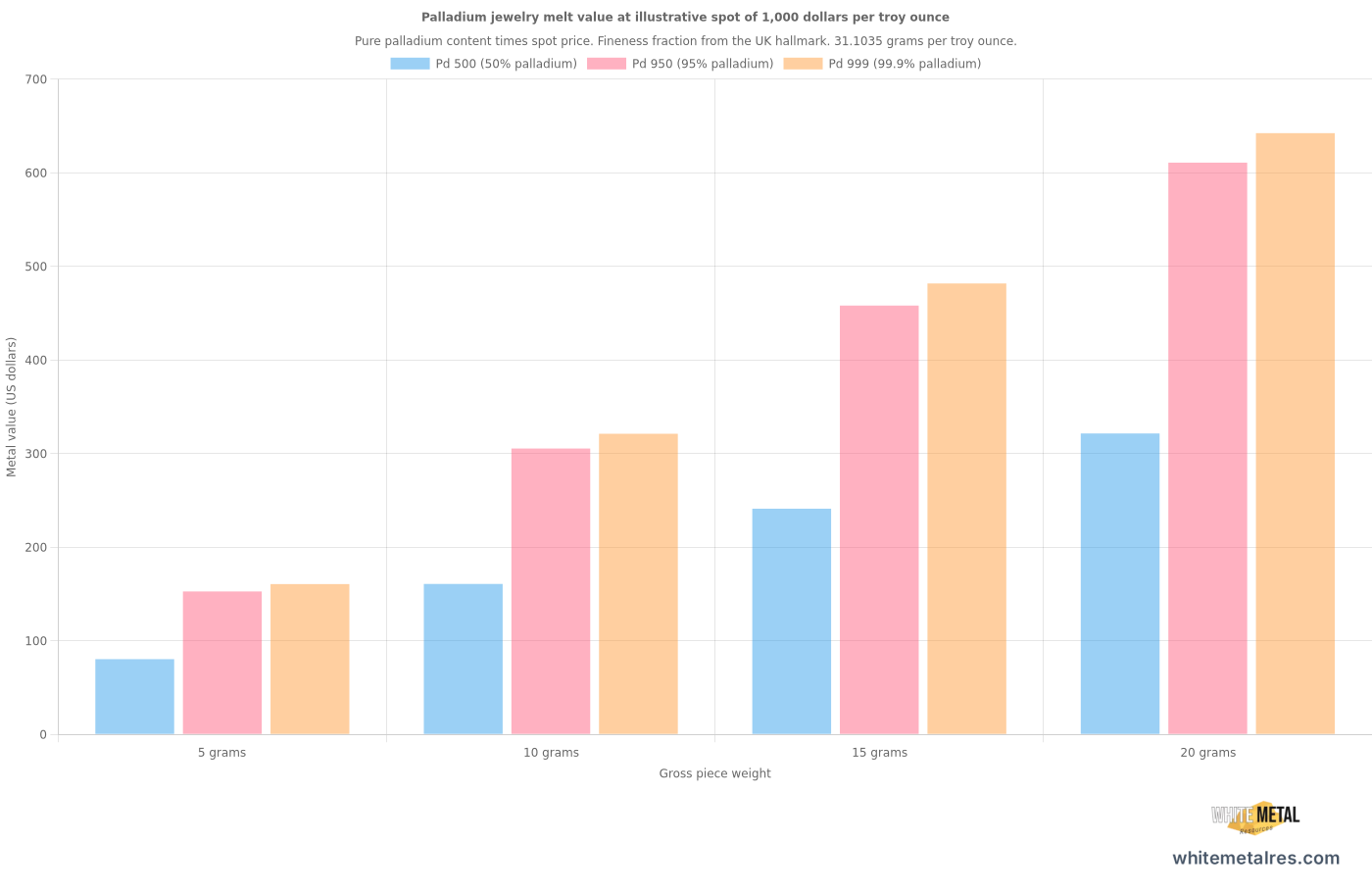
| Piece | Fineness fraction | Pure palladium (grams) | Pure palladium (troy ounces) | Metal value at 1,000 dollars per troy ounce |
|---|---|---|---|---|
| 5 g Pd 500 | 0.500 | 2.5000 | 0.08038 | about 80.38 dollars |
| 5 g Pd 950 | 0.950 | 4.7500 | 0.15272 | about 152.72 dollars |
| 5 g Pd 999 | 0.999 | 4.9950 | 0.16059 | about 160.59 dollars |
| 10 g Pd 500 | 0.500 | 5.0000 | 0.16075 | about 160.75 dollars |
| 10 g Pd 950 | 0.950 | 9.5000 | 0.30543 | about 305.43 dollars |
| 10 g Pd 999 | 0.999 | 9.9900 | 0.32119 | about 321.19 dollars |
| 15 g Pd 500 | 0.500 | 7.5000 | 0.24113 | about 241.13 dollars |
| 15 g Pd 950 | 0.950 | 14.2500 | 0.45815 | about 458.15 dollars |
| 15 g Pd 999 | 0.999 | 14.9850 | 0.48178 | about 481.78 dollars |
| 20 g Pd 500 | 0.500 | 10.0000 | 0.32151 | about 321.51 dollars |
| 20 g Pd 950 | 0.950 | 19.0000 | 0.61086 | about 610.86 dollars |
| 20 g Pd 999 | 0.999 | 19.9800 | 0.64237 | about 642.37 dollars |
Values are direct computations from stated fineness fractions, 31.1035 grams per troy ounce and an illustrative palladium spot of 1,000 dollars per troy ounce. Not a quote from any refiner. Not a forecast of future palladium prices. Reprice at any other spot by proportional scaling. Sources: Wikipedia article on palladium for the United Kingdom fineness marks; Wikipedia article on fineness for the troy ounce conversion. Checked August 2026.
The resale reality: refiners, spreads and brand premium
Palladium jewelry sells to three broad buyer types, and the paid percentage of underlying metal value differs by tier. National precious metals refiners pay the highest percentage, typically 75 to 85 percent net of a refining fee on a clean palladium lot. Local coin shops and jewelry buyers pay less, often 50 to 70 percent, because they resell the piece to a refiner rather than melting it directly.
Palladium spreads are wider than platinum spreads at every tier. Fewer refiners take palladium as an inbound flow. Fewer coin dealers keep a palladium inventory book. Fewer online scrap services publish a firm palladium payout matrix. The result is a thinner bid on the same underlying metal.
Brand premium at melt is essentially zero. A signed maker punch on a palladium band does not lift a refiner payout above metal content. A refiner buys the piece as scrap metal input and pays only on the assayed pure palladium recovered. That is true for a Tiffany platinum band, a Cartier gold band and a palladium band alike.
A collector premium can apply in a narrow channel. Documented designer palladium jewelry from a named studio can sell above melt at auction or through a specialty vintage dealer. That is a slow, uncertain path with commissions and holding time. A refiner sale is a fast path at metal value only.
Held in a retirement account, palladium is a different topic entirely. Physical palladium inside a self-directed IRA must sit at specific fineness thresholds in an approved depository, which we cover in our palladium IRA guide. Jewelry cannot enter that framework and is not on the same track as retirement bullion.
A six step check before you sell palladium jewelry
The steps below turn the melt math and the resale reality into a repeatable process. Follow them in order and the seller keeps the underlying metal value visible at every stage.
- Read the mark under a loupe. Look for Pd followed by 500, 950 or 999. In United Kingdom pieces from 2010 forward, a small assay office town mark and a date letter usually sit next to the fineness number. Photograph the mark for later reference.
- Weigh the piece on a scale that reads to the tenth of a gram. Jewelry scales and kitchen scales both work at that resolution. Record the gross weight. Stones or non palladium fittings, if any, come off the payable weight.
- Look up the current palladium spot price in United States dollars per troy ounce. Public quote sources display it during market hours. Note the time you pulled the quote because spot moves continuously.
- Compute pure metal content and metal value. Multiply weight in grams by the fineness fraction. Divide by 31.1035 grams per troy ounce. Multiply by the spot price. The result is the melt value ceiling before refiner spread.
- Ask two or three buyers for a quoted net percentage of underlying value. A national refiner should quote a firm net percentage on a clean palladium lot. A coin shop or jewelry buyer should also quote a percentage. Compare the quotes against the computed ceiling.
- Choose the highest net payout in dollars per gram of recovered metal. A higher headline percentage on a hidden fee can pay less than a lower headline percentage on a transparent settlement. The final metric is the total dollars paid divided by the piece weight, compared across bids on the same piece.
Any dealer who refuses to state a paid percentage of underlying value in writing before the piece leaves your hands is a dealer to walk away from. The Federal Trade Commission publishes consumer guidance on bullion transactions that reinforces the same principle: verify the pricing mechanics in writing before the transaction.
A worked example on a 6 gram Pd 950 wedding band
Picture an inheritor holding a plain palladium wedding band from a marriage in 2006. The band carries a small Pd 950 stamp on the inside surface, next to a faded maker punch. A jewelry scale reads 6.0 grams gross weight. The seller wants a fair number before choosing a buyer, at an illustrative palladium spot price of 1,000 dollars per troy ounce.
- Gross weight: 6.0 grams of Pd 950 palladium jewelry.
- Fineness fraction from the Pd 950 mark: 0.950 pure palladium by weight.
- Pure palladium content: 6.0 grams times 0.950 equals 5.70 grams of pure palladium in the band.
- Convert to troy ounces: 5.70 grams divided by 31.1035 grams per troy ounce equals 0.18326 troy ounces of pure palladium.
- Metal value at 1,000 dollars per troy ounce: 0.18326 times 1,000 equals about 183.26 dollars in underlying metal content. This is the ceiling before any refiner spread.
- National refiner net payout at 80 percent: 0.80 times 183.26 equals about 146.60 dollars in the seller pocket.
- Local jewelry buyer payout at 60 percent: 0.60 times 183.26 equals about 109.95 dollars in the seller pocket.
- Walk in offer at 40 percent: 0.40 times 183.26 equals about 73.30 dollars.
The paid amount for the same 6 gram Pd 950 band ranges from about 73 dollars at a low walk in offer to about 147 dollars at a national refiner. That gap is what a seller keeps or loses by choosing which door to walk through. The underlying metal is worth the same 183.26 dollars in every case at the illustrative 1,000 dollar spot.
Substitute a different spot to reprice. At 800 dollars per troy ounce, the same 6 gram Pd 950 band holds about 147 dollars in metal, so an 80 percent refiner net pays about 117 dollars. At 1,200 dollars per troy ounce, the band holds about 220 dollars in metal and the same refiner net pays about 176 dollars.
Figures are illustrative computations from a labeled example spot price, not a quote from any specific refiner, and not a forecast of future palladium prices. Spot prices move continuously. This is not tax or investment advice. Consult a licensed advisor for personal decisions.
Limits and honest caveats
Not every palladium jewelry piece follows the standard playbook. A few edges are worth naming before the transaction.
A Pd 500 alloy is 50 percent palladium and 50 percent base metals by weight. Some Pd 500 alloys use silver or copper for the balance, which affects color but not the palladium metal value. A refiner assays the piece and pays only on the recovered palladium content, so a Pd 500 band holds about half the metal value of a same weight Pd 950 band at the same spot.
Older United States palladium jewelry marked 950Pd without an assay office stamp may not test to 950. A refiner XRF read that comes back at 90 or 92 percent palladium instead of 95 will pay on the tested composition. Unmarked palladium jewelry is treated as unmarked scrap and pays only after full assay of the melted lot.
Palladium prices swing more than gold or silver. The 2018 to 2022 palladium price cycle ran from below 900 dollars per troy ounce to above 3,000 dollars per troy ounce and back, per the Wikipedia article on palladium citing London Bullion Market Association and industry data. A quote pulled last month is not the quote available today, and a real seller reprices against the current spot before every transaction.
A palladium wedding band with sentimental value carries a private premium that no refiner recognizes. Some sellers hold pieces rather than send them for melt. That is a legitimate personal choice, not an economic mistake, and this page does not argue against it. It only computes what the metal is worth if the seller does decide to sell.
Held in a retirement account, palladium becomes a different topic. Physical palladium inside a self-directed IRA follows federal fineness and depository rules. Jewelry does not enter that framework and cannot be treated as retirement bullion. Refer to our palladium IRA guide for that side of the topic.
Palladium jewelry questions, answered
What does Pd 950 mean on a wedding band?
Pd 950 means the band is 950 parts palladium per 1,000 by weight, or 95 percent pure palladium. The remaining 5 percent is usually ruthenium, sometimes with small amounts of copper or gallium for hardness and casting behavior. The mark is a legal fineness stamp under the United Kingdom hallmarking system in force since January 2010.
Is a Pd 500 mark real palladium?
Yes. Pd 500 means 500 parts palladium per 1,000 by weight, or 50 percent pure palladium. The other 50 percent is alloying metal. Pd 500 is a legal United Kingdom hallmark fineness, though less common on wedding bands than Pd 950. A refiner pays on the assayed palladium recovered, so a Pd 500 piece holds about half the metal value of a same weight Pd 950 piece at the same spot.
How much is a palladium wedding band worth?
Metal value scales with weight, fineness and palladium spot price. A 5 gram Pd 950 band holds about 152.72 dollars in pure palladium at an illustrative spot of 1,000 dollars per troy ounce. A 10 gram Pd 950 piece holds about 305.43 dollars at the same spot. A refiner typically pays 75 to 85 percent of that ceiling, so the net check on a clean lot lands below the metal value.
Why did palladium wedding bands become popular in the mid 2000s?
The platinum price rose steeply in early 2004 while palladium sat near 200 dollars per troy ounce. Jewelers cast palladium bands as a cheaper look alike to platinum, and China alone consumed 37 tonnes of palladium in 2005 for jewelry, per Wikipedia citing Johnson Matthey and United States Geological Survey data. When the price gap narrowed, demand fell to 17.4 tonnes in 2009, and the palladium bridal channel never returned to peak.
Where can I sell palladium jewelry?
National precious metals refiners pay the highest percentage of underlying value on palladium lots, typically 75 to 85 percent net of refining fees. Local coin shops and jewelry buyers pay 50 to 70 percent because they resell to a refiner. Auction and specialty dealers may pay above melt only for documented designer pieces. Ask any buyer for the net payout in writing before the piece leaves your hands.
Does a maker signature raise the melt payout?
No. A refiner buys the piece as scrap metal input and pays only on the recovered pure palladium. A signed maker punch does not lift the melt number. A collector premium can apply above melt for a documented designer or antique piece sold at auction or through a specialty vintage dealer, but that is a separate channel with commissions and holding time.
How do I know a palladium mark is genuine?
A United Kingdom palladium item from January 2010 forward should carry a maker punch, a fineness number inside a shape that identifies palladium, an assay office town symbol, and often a date letter. All four should be crisp under magnification. Any refiner or coin dealer can run an XRF surface read that confirms the palladium content within seconds. Discrepancies between the stamp and the XRF result are common on older or overseas pieces.
Can I hold palladium jewelry in a retirement account?
No. Physical palladium held inside a self-directed IRA follows federal fineness and depository rules that apply to bullion products, not to jewelry. A palladium wedding band or ring cannot enter that framework. Our palladium IRA guide covers the eligible product list and the rules that separate retirement bullion from consumer jewelry.
Sources
- Wikipedia, Palladium: United Kingdom palladium hallmarking became mandatory in January 2010 with fineness marks of 500, 950 and 999 parts per 1,000; palladium jewelry consumption reached 37 tonnes in 2005 and fell to 17.4 tonnes in 2009; palladium used since 1939 as a white gold alloy component. Checked August 2026.
- Wikipedia, Hallmark: The United Kingdom Hallmarking Act was amended in July 2009 to include palladium from January 2010; overview of assay office town marks and fineness stamps. Checked August 2026.
- Wikipedia, Fineness: millesimal fineness definitions for precious metals; standard troy ounce equal to 31.1035 grams. Checked August 2026.
- Birmingham Assay Office, hallmarking services: statutory hallmarking of gold, silver, platinum and palladium items under the United Kingdom Hallmarking Act. Checked August 2026.
- The Goldsmiths Company Assay Office London: institutional United Kingdom assay office for hallmarking precious metal articles including palladium. Checked August 2026.
- Federal Trade Commission, Consumer Advice: Investing in Bullion and Bullion Coins (bullion transaction guidance, verify pricing mechanics and fees in writing before the transaction). Checked August 2026.
- United States Geological Survey, Platinum Group Metals Statistics and Information (annual reports on palladium supply, demand and recycling flows including jewelry share). Checked August 2026.
- Johnson Matthey PGM Market Reports: reference data on annual palladium supply, demand and price ranges cited by USGS and other public sources. Checked August 2026.
